

In the United States, courier production workers' average hourly earnings and producer prices for courier and express delivery services diverged through late 2025. With both series rebased to January 2019 = 100, the gap widened until the price index stood 25.2 points above earnings in December 2025. After briefly trailing earnings in late 2021, delivery prices outpaced wages, reaching 166.5 by August 2026 compared to 128.4 for earnings.
Divergence between courier delivery prices and production earnings
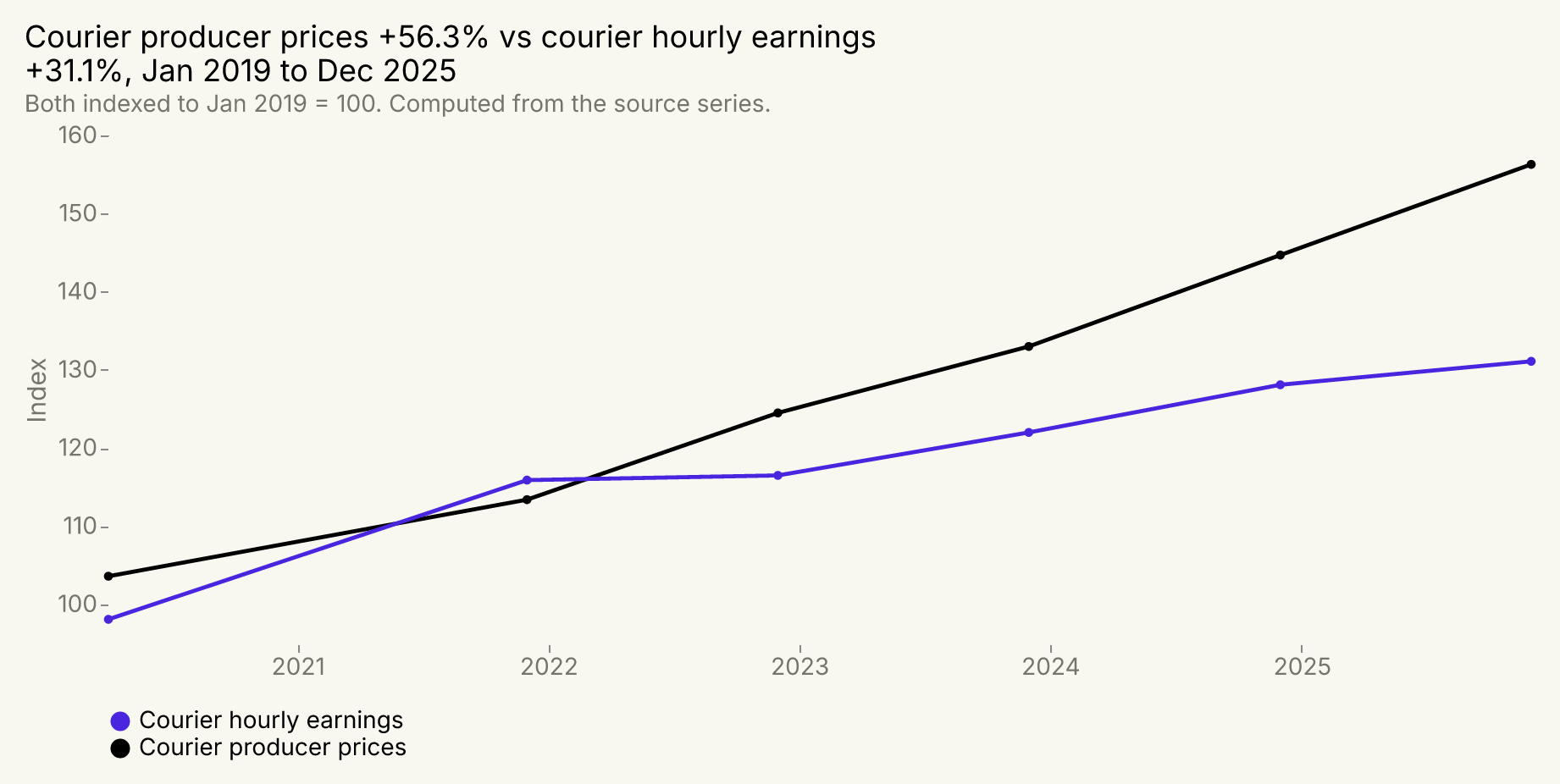
Courier delivery prices separated from courier production worker hourly earnings across the tracked dates. The gap between the two indexes widened after both series were rebased to January 2019 = 100. In April 2020, the price index reached 103.6 and the earnings index was 98.09, where the price index was 5.51 points above the earnings index. By December 2021, the earnings index registered 115.9 while the price index registered 113.4, meaning the earnings index was 2.5 points above the price index. By December 2022, the price index reached 124.5 against 116.5 for earnings, where the price index was 8 points above the earnings index.
The price index widened its advantage in subsequent years. In December 2023, the price index reached 133.0 while the earnings index was 122.0, where the price index was 11 points above the earnings index. In December 2024, the price index recorded 144.7 against 128.1 for earnings, where the price index was 16.6 points above the earnings index. By December 2025, the price index reached 156.3 compared to 131.1 for earnings, where the price index was 25.2 points above the earnings index.
Interpretation: The earnings index briefly moved above the price index before the price index reversed and widened the separation.
Courier production worker earnings December-on-December growth

Courier production workers' average hourly earnings shifted across each December-on-December comparison period. In 2020, December-on-December earnings increased 7.7%, before annual growth peaked at 11.8% in 2021. Gains then slowed to 0.5% in 2022.
Earnings growth rebounded to 4.7% in 2023 and rose to 5.1% in 2024. The December-on-December increase then moderated to 2.3% in 2025.
Interpretation: Annual earnings growth peaked early in the series and moderated downward.
Courier producer prices December-on-December growth

Courier and express delivery service producer prices recorded positive December-on-December changes across each measured year. Producer prices rose 3.7% in 2020 and accelerated to 8.7% in 2021, reaching a peak increase of 9.8% in 2022.
Price increases continued at 6.9% in 2023 and 8.8% in 2024. The December-on-December change registered 8.0% in 2025.
Interpretation: Annual price growth reached its highest rate midway through the period before settling at a lower positive rate.
Courier prices and earnings cumulative expansion across the multi-year span
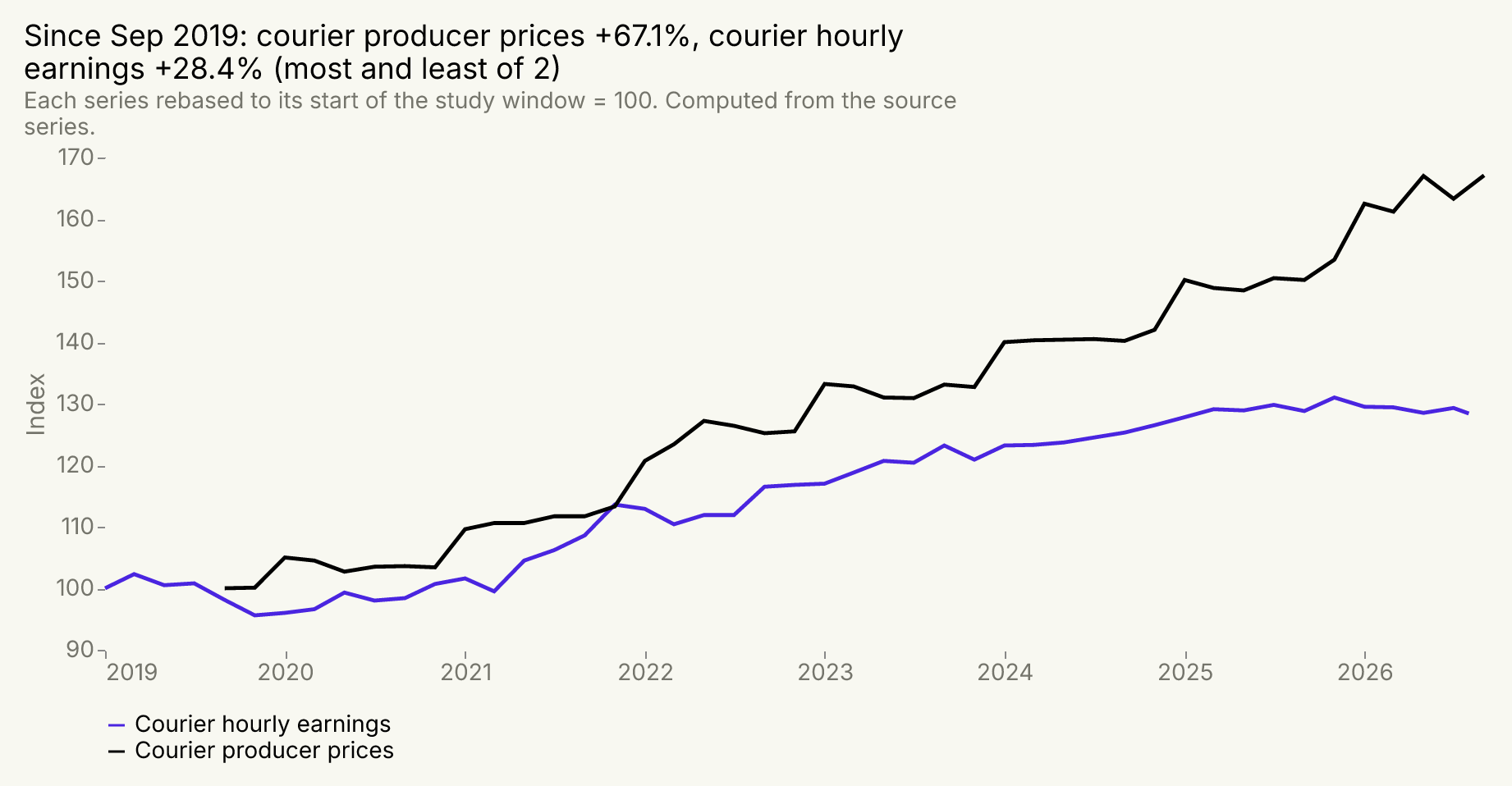
Courier producer prices and earnings expanded at different rates across their multi-year records. Producer prices for courier and express delivery services grew 67.1% from September 2019 to September 2026, starting from an initial index value of 239.8. Courier production workers' average hourly earnings rose 28.4% from January 2019 to August 2026, starting from 18.8 dollars per hour.
Courier producer prices and earnings indexed levels and twelve-month movements

Courier producer prices outpaced courier production worker earnings in indexed comparisons through August 2026. On their shared base period, the courier producer price index reached 166.5 in August 2026 while the earnings index reached 128.4. For producer prices for courier and express delivery services, the year-over-year change was 11.4% from September 2025 to September 2026, rising from a year-ago level of 359.903 to 400.821 within a twelve-month range spanning 359.711 to 400.821 from October 2025 to September 2026. Courier production workers' average hourly earnings changed -0.9% from August 2025 to August 2026, moving from 24.35 dollars to 24.13 dollars within a twelve-month range bounded by 24.13 dollars and 24.64 dollars from September 2025 to August 2026.
What this means
Producer prices for courier and express delivery services expanded 67.1% from September 2019 to September 2026, while courier production workers' average hourly earnings grew 28.4% from January 2019 to August 2026. The gap between the two indexes, with both rebased to January 2019 = 100, reached 25.2 points in December 2025. Over the most recent twelve months, producer prices increased 11.4% through September 2026, while production worker hourly earnings decreased 0.9% through August 2026. The data tracks producer prices and production worker hourly earnings from establishment surveys; it does not measure shipment volume, operating margins, or total sector headcount.
Methodology
Finmile compiled these figures from monthly time series published by the U.S. Bureau of Labor Statistics. Couriers avg hourly earnings, production (USD) (series CES4349200008) covers 92 periods across the span January 2019 to August 2026 and measures average hourly earnings in dollars for production and nonsupervisory employees. PPI couriers & express delivery services (series PCU492110492110) covers 93 periods across the span January 2019 to September 2026 and measures producer price index levels for the industry classification. To calculate divergence, both series were rebased to January 2019 = 100, and the earnings index value was subtracted from the price index value at December intervals from 2020 to 2025, alongside April 2020. The dataset tracks establishment-level wage reporting and producer price index levels; it does not track operating margins, total employment count, or shipment quantities.